

Let's just start with this comment... this post is likely going to ruffle a few feathers. History is written, it is what it is.
That said, everything herein is researchable, accurate, and as true as history is capable of portraying.
When I mention the name King James, most people immediately and synonymously link him with the Bible. And for good reason. The KJV of the Bible is one of the longest, most trusted translations of the English Bible, thus contributing to the ease of recognition. But let's take a quick hop back into history and learn about the actual man behind the association with the Bible, and what brought all of this about. As one might imagine, there are many interesting pieces of history affiliated with this story, things maybe not so much for the faint of heart.
King James was the son of a very notorious Queen, Mary, Queen of Scots (1542–1587). His mother was forced to abdicate the thrown while James was just a baby. As such, he became King of Scotland at the ripe old age of just 13 months. Growing up without parents, he was raised by regents and various political factions who spent their days trying to educate and influence baby James. His entire youth was plagued by constant kidnapping and assassination attempts, which led to great paranoia throughout his adult life. Still, James was very well educated. Shockingly educated. He was, not even arguably, the most well-read, bookish monach (eventually) England ever had. For example, he was multi-lingual, passionate about literary debate, wrote theology and philosophy, was an author, and challenged scholars of the time. King James was different from other kings in that he didn't find glory in war. In fact, he despised violence and rather chose diplomacy, treaties, and negotiations. He also wasn't much for hygiene and was a bit of a slob, despite arguing his whole life that Kings were as divine as God, and challenging a king was basically criticizing God's authority.
Here's where the fallen humanity of the king truly shined. Most all historians also agree that King James was bi-sexual. He likely had many intimate relationships with men, two of which are well documented (Robert Carr and George Villers, who was Duke of Buckingham). Rumors emerged in later years about a possible tie to pedophilia, but this claim is mostly speculation or rumor, with no evidence to support such a claim either way. Still, neither are something that you would associate with someone best known for commissioning an early translation of what would become the most mainstream Bible of the age.
But wait. There's more.
James made a lot of huge strides in bringing peace and unity to his areas of rule. James was the catalyst for Great Britain. He ruled both Scotland (as King James VI) and England (King James I), during which time his personal paranoia began to take quite a grip on him, no doubt due to a lifetime of experiences which would clearly corroborate such tendencies.
During the North Berwick Witch Trials, several accused women confessed (under torture) to summoning storms, trying to sink James ship, and using magic against the king. Some of this very thing, he experienced while at sea. Thus, James was convinced that witches personally tried to kill him. Which led him down an unhealthy path of obsession with witches, demons, and dark magic. In 1597, James published a book which he, himself had authored, titled Daemonologie (in modern English, Demonology), published prior to his commissioning of the KJV of the Bible.
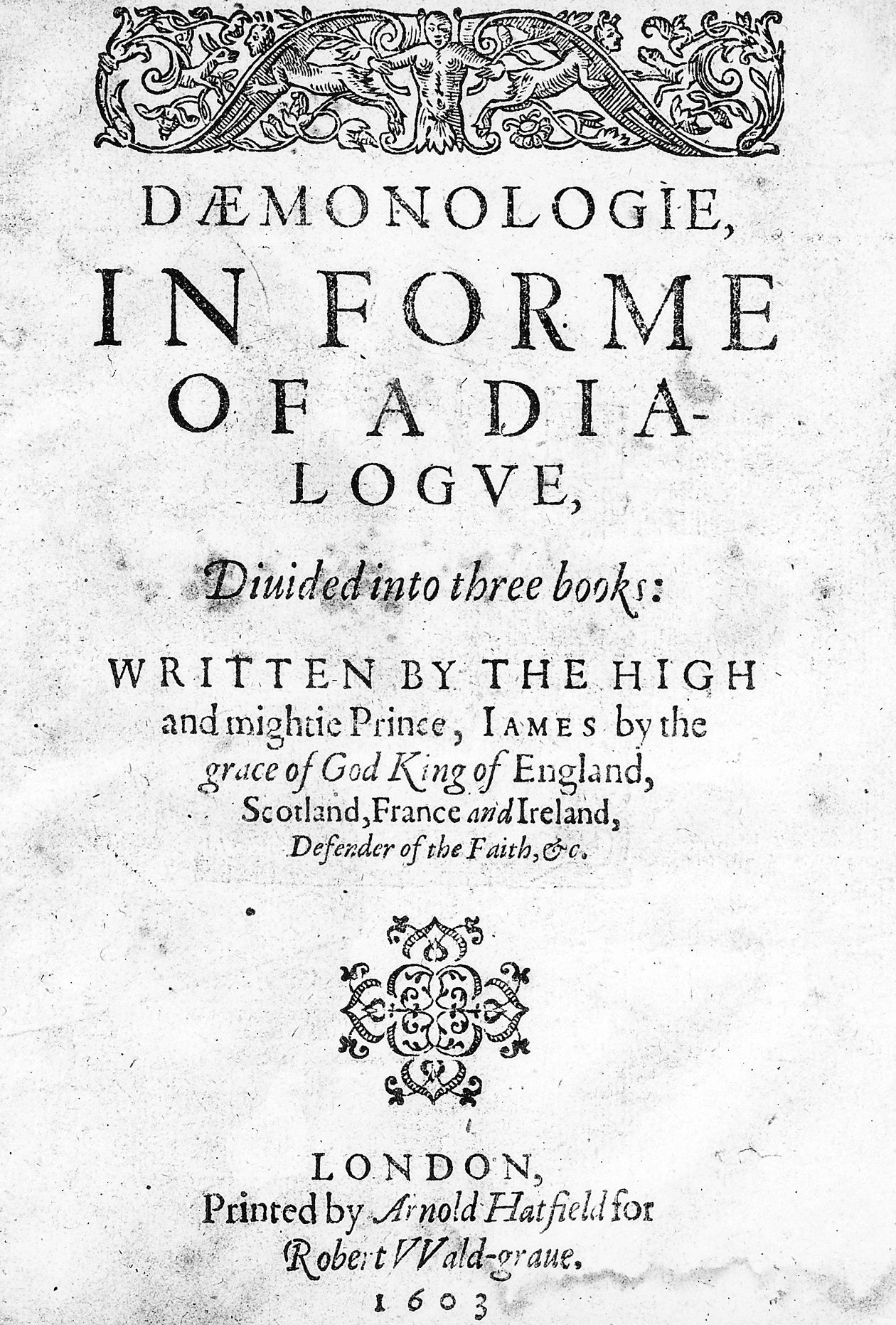
In his book, he contends that demons and witches are real, witchcraft is a genuine and supernatural threat, and it is the obligation of the state to pursue, prosecute, and execute these witches, thus contributing further fuel to the witch trial movements (even the popular one's here in America that we have all heard about). In his book, he teaches how demons operate, about witches pacts with Satan, how possession works, and much more. This became a VERY influential book of its time, on both English, Scottish, and Puritan beliefs.
Now, fast forward, in 1604 James, who had been King of England for about a year, commissioned his own translation of the Bible, which was completed in 1611. This commission was a result of an event called The Hampton Court Conference, whose goal quite simply was to stop churches from fighting. A puritan made the suggestion that a new translation be created for all people to use, James liked the idea, the rest became written into the pages of history.
Seven years of hard work by fifty of the most well regarded scholars in England, who were linguists, Hebrew and Greek experts, theologians, and university professors, all culminated into the translation that many still read today. Most of these well educated men were from Oxford, Cambridge, and Westminster, boasting some of the best minds of the time.
Before completion of this project, there was no unified bible. And most of them contained political influence, which the monarchy obviously despised. There was various Bible content available, but few were available to the general public. These included The Bishops Bible, The Gutenburg Bible (which was the first book ever to be mass produced with the invention of the printing press), The Geneva Bible (the most popular), and the Tyndale translation of the New Testament. Interestingly, roughly 80-90% of the finished KJV of the bible came from the earlier Tyndale translation.
Because scripture was mostly read aloud in churches, James wanted it to sound somewhat poetic, which is why the 'Shakespearean' stylizing was applied... this was very intentional, though it had nothing whatsoever to do with how English was traditionally spoken at the time.
The King James version of the bible didn't spread in popularity because it was a "better" or more accurate bible, it just happened to be the perfect storm of politics, technology, and poetry. The Geneva Bible was the main competitor of the time, but the reality is, other printers simply stopped printing other various versions of the bible over time, driving up the demand for the KJV. Eventually, it became the most widely printed English Bible, by matter of supply and control. Classic power move, but this literally drove the popularity of the Bible to greater heights. Later, distribution channels improved, etc., etc., etc. Coincidentally, this version also arrived right as British colonies began populating America. So early America used it. Follow that with years of no real competition (300 years), and we arrive at all things understood about the popularity of this version of the Bible.
Today, there are still people in the Christian faith (usually charismatic) who claim that this particular translation is God's one and only spoken word. Not true. In fact, as the years have passed, our tools, insights, and ability to translate and understand earlier text (think dead sea scroll discoveries), have provided even more insight into earlier culture and linguistics. So undoubtedly with time, discovery, and technology, there are more "accurately" translated versions available today.
Still, the good ol' KJV sounds good when read aloud. It also served to shape English vocabulary to some degree. It accomplished unifying churches in a time of division, it made the gospel more readily available and understandable, and all of this happened in a very well timed (or better phrased- ordained) manner.
And in all honestly, it shouldn't bother you that this translation was commissioned by a bi-sexual author, obsessed with demons and witchcraft. And this comment is not tongue in cheek... did God not use murders, liars, cheaters, doubters, and various other sinners throughout history to bring some of the greatest glory to His Kingdom? Yes.
Knowing the facts shouldn't reshape the way you view your Bible, it should reshape the way you understand the sheer and almighty power of our God. A God who can use everything for His own glory and honor. That's the God that I am proud to serve, one who can not be slowed; can not be stopped; and can use even the worst in society, intended for all the wrong things, to bring holy change to the entire world. That's my God, who I am both humbled by, in awe of, and willingly serve.
Knowing the history makes us more capable of speaking to the things that we are passionate about. Knowing how, when, why, and what made the Bible readily available as a resource, and the history of these things, makes you more believable in your ability to sell its legitimacy to others. Knowing what and why you believe things is important.
Ask God to reveal these things to you and to bless you with the ability to retain and share them with others. Like James, and so many others throughout history, you too are here by design. You have purpose. Lean into your calling! In the waiting, feed your mind with the Word of God so that He may use you too as a catalyst of His glory.
~ Devin
Devin Osborne


